
Birmingham Previous Residents by Era
Previous residents of one Birmingham address are best treated as a sequence of dated snapshots. The Oakland County property record can normalize a current parcel. The Register of Deeds index can lead backward through transfers. Historical directories and newspapers can add household clues, while museum and historical-society material can explain an old street reference. None of those sources alone proves an uninterrupted line of residence.
| Source | Years it covers | Where held | What it can show |
|---|---|---|---|
| Oakland County Clerk/Register of Deeds Super Index | Recorded documents from January 1, 1964, except subdivision plat maps | Online index and Register of Deeds route | Recorded parties, date, PIN, document type, and an image-order path |
| Oakland County Property Gateway | Current parcel research route | County property portal | Address or PIN bridge to parcel-oriented research |
| Polk's Birmingham City Directory | Confirmed 1937, 1949, 1954, 1957, 1959, 1969, 1974, 1975, 1977, 1979, and 1983-85 | Oakland County Historical Society holding list | Dated name and address leads where printed |
| Birmingham-Bloomfield Hills Community Directory | Confirmed 1986 | Oakland County Historical Society holding list | A further dated household lead |
| Newspapers, maps, and local-history collections | Collection-dependent | Baldwin, Birmingham Museum, OCPHS, and Library of Michigan | Context, notices, maps, and historical address leads |
Start near the date you need. A recent title question belongs in the county land records, while a twentieth-century household question may need the shelf list and microfilm route before a deed search can supply useful context.
Birmingham Previous Residents Start with Parcels
Oakland County Property Gateway accepts a PIN or an address, including partial and wildcard formats. The published minimum is five characters. Address examples documented for the portal include partial strings such as 1200 S and wildcard patterns such as 1% Main; these are portal examples, not Birmingham parcel values. The result is a bridge from a street string to a parcel and legal description, not a list of people who lived there.
Write down the original address, the normalized address, the parcel or PIN, municipality, legal description, and the source date. A property address can change while the legal description remains useful. Oakland County tax material can also be searched by municipality and a ten-digit parcel ID, or by street number and name, but a tax-bill owner is not proof of a current household at the location.
The Property Gateway address and PIN search is the first parcel bridge in the backward trail.
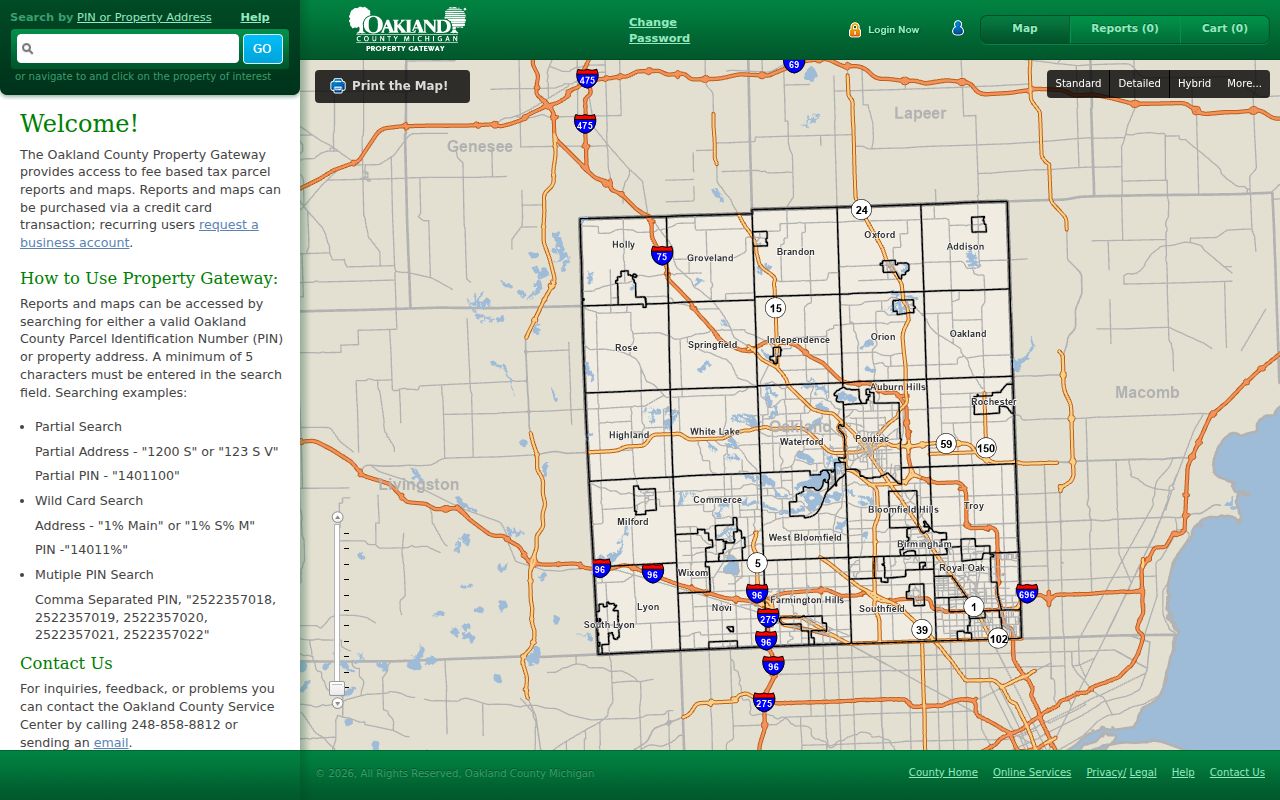
After a parcel is normalized, record the date and source before moving to deed parties or historical collections.
Oakland Deeds Behind Birmingham Previous Residents
The Oakland County Clerk/Register of Deeds Super Index is the recorded-land index for a backward title trail. Simple searching can use a party name, property address, subdivision, or document type. Its advanced fields include Grantor and Grantee, recorded or file date, instrument number, document type, subdivision, block, and lot. Results may show document type, recorded date, PIN, Grantor, and Grantee. Treat an indexed result as a lead until the recorded image or official copy is reviewed.
- Use the current parcel record to capture the owner name, PIN, and legal description.
- Search the current owner's purchase record in Super Index by name, address, subdivision, or instrument details.
- Record the seller as the grantor and the buyer as the grantee, plus the recorded date, PIN, and document type.
- Search the earlier seller as a grantee to locate that person's acquisition record, then repeat with date and name variants.
- Stop at the 1964 online boundary and ask the Register of Deeds counter for the appropriate earlier in-person, book, microfilm, or archival route.
- Grantor / grantee
- The grantor is the party transferring an interest in the document; the grantee is the party receiving it. The names should be read with the document type and date.
- Chain of title
- A dated sequence of recorded transfers tied to the same parcel or legal description. It is not a list of every household member.
- Legal description
- The parcel wording used in land records, such as a subdivision, block, and lot. It can be more stable than a street label when addresses change.
Index searches are free. Selected document images move to a cart, where the published instructions list a $5 transaction fee, $1 for a document up to three pages, $0.50 per page after three, and a $50 maximum per document. Confirm current charges and obtain the right copy type before relying on a transfer.
Birmingham Previous Residents Before 1964
The online Super Index begins on January 1, 1964, except subdivision plat maps. That cutoff is a records-access boundary, not evidence that a Birmingham property had no earlier transfers or occupants. The inspected official material did not expose a definitive pre-1964 online, onsite book, or microfilm inventory. Do not guess at a book number or claim an earlier deed was digitized.
Use the Oakland County Clerk/Register of Deeds as the first fallback. The office is at 1200 N Telegraph Road, Pontiac, Michigan 48341; its phone is 248-858-0597 and email is deeds@oakgov.com. Ask for guidance using the legal description, subdivision, block and lot, parties, and date range already gathered. The documented access sweep also includes in-person research, a mail or copy order, phone or email assistance, and library or archival help for historic material.
For a non-indexed Birmingham municipal record, a narrowly framed request under Michigan FOIA, MCL 15.231 et seq. can ask for an existing record by address, Sidwell number, date range, or permit number. FOIA does not require the city to create a prior-resident list.
Note: The 1964 boundary is an access fact, so preserve it in the research log rather than filling the earlier gap with assumptions.
Birmingham Address Variants Over Time
An old street string needs normalization before it is merged with a parcel. Birmingham research should test Woodward Avenue, Old Woodward Avenue, Hunter Boulevard, abbreviated suffixes, and the street number. The exact official ordinance or year for a relevant renaming was not captured, so a historical label should not be converted into a current one without supporting evidence.
Pair at least two dated sources: a directory or newspaper plus a deed, map, census, tax record, cemetery record, or municipal document. A current PIN can be a better bridge than a changed street label. Sanborn maps are an authoritative map route through the Library of Congress, but exact Birmingham sheets and years were not verified in the source review. Record a map title, year, and sheet before drawing a parcel conclusion.
Birmingham Previous Residents in Directories
Ownership is only one layer of the past. The confirmed Polk's Birmingham volumes and the 1986 community directory can provide dated household leads, while census records, obituaries, cemetery files, and probate material can test a name against a separate event. The collections themselves, their confirmed years, and their access limits are described in the Birmingham city directory collections.
- Choose a directory year close to the date suggested by the deed chain or a family record.
- Copy the page citation, name form, address text, and any household notation exactly as printed.
- Compare the address with a census schedule or another dated record rather than treating one listing as final proof.
- Use an obituary, Greenwood Cemetery inquiry, or public probate record as a later trail endpoint when the dates fit.
- Keep every result tied to its source date, because a name in a directory, deed, or newspaper reflects a particular purpose and moment.
The city directory years are selective confirmed holdings, not a continuous annual run. A missing name can reflect a move, a gap, a spelling variation, a listing change, or a volume that has not been located.
Birmingham Newspapers and House History
Birmingham Museum research services can point to local files, photographs, and staff knowledge through an appointment route. Public museum hours are Tuesday through Saturday, 1 to 4 p.m.; research staff hours are Tuesday through Friday, 9 to 4 by appointment. Baldwin's 2025 board packet reports 2,149 microfilm reels across 11 topics and identifies May 2, 1878 as the earliest Birmingham Eccentric issue. Search newspaper material by name variants, street name, organization, and date range, then retain the issue date and page or reel reference.
The museum research route is represented in this image. It identifies an appointment source for Birmingham history, not a verified resident record.
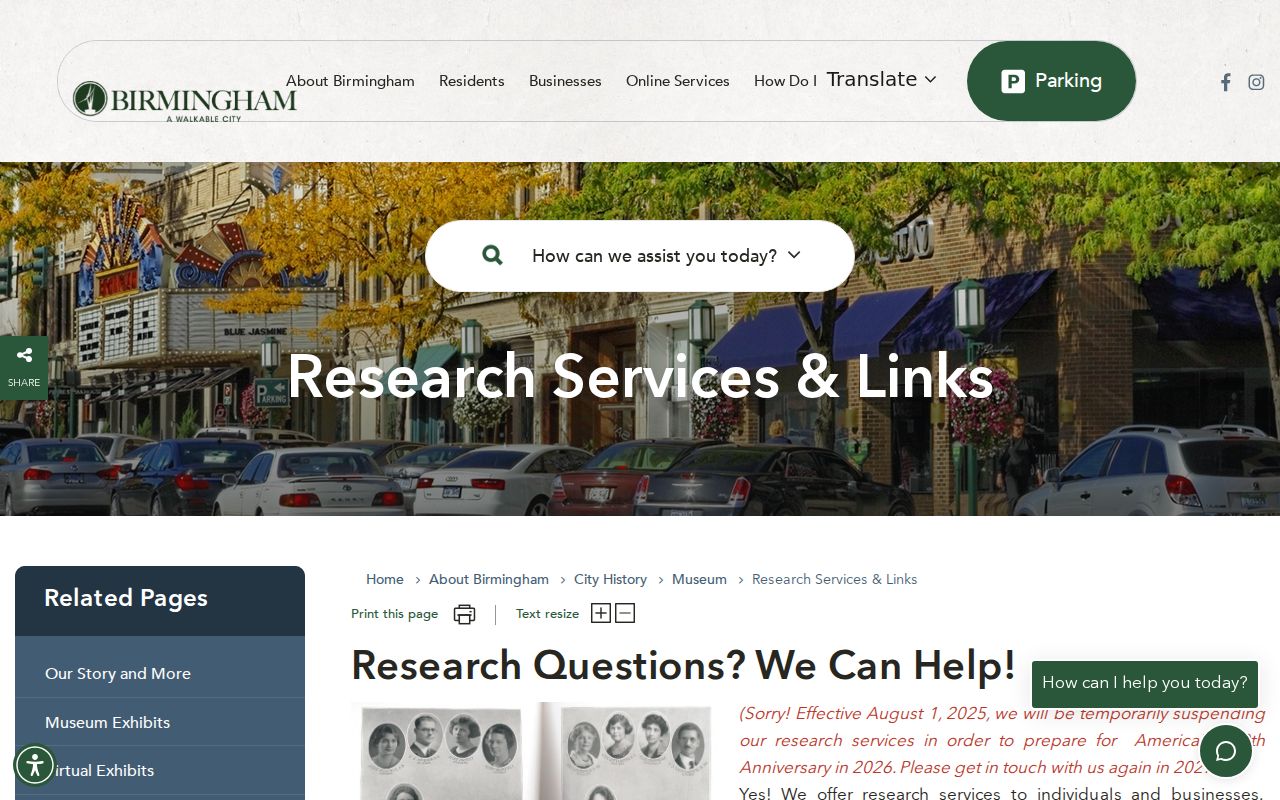
Use a museum result as a source lead, then document its collection title, date, restrictions, and any reproduction terms before drawing conclusions.
The Oakland County Historical Society shelf list can also route a search to its Birmingham property and manuscript material.
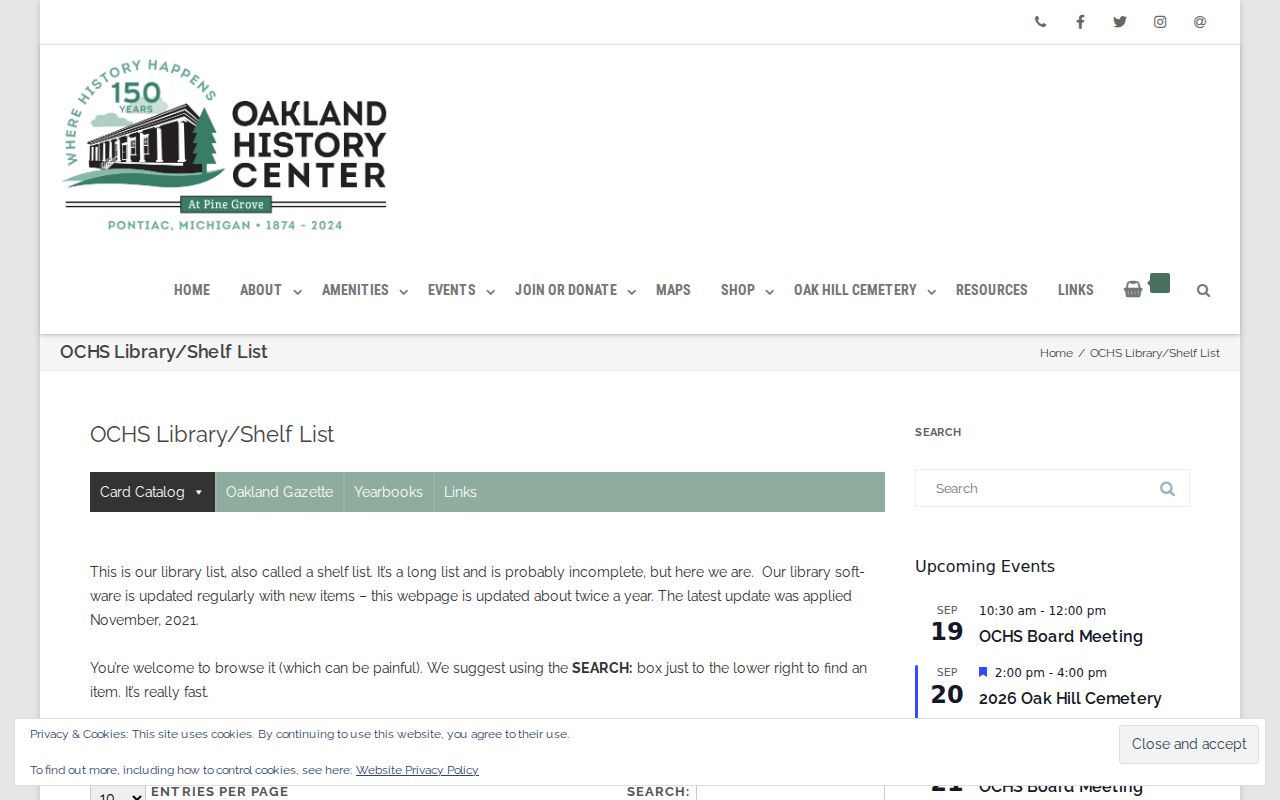
Ask the society for an exact box, folder, date, restrictions, scan cost, and whether a name is indexed before treating a listed collection as immediately available.
Birmingham Previous Residents and Privacy
Old records are not a license to collapse people into a permanent address history. Michigan's Address Confidentiality Program can provide an eligible participant with a designated address and mail forwarding. A displayed address may therefore be a protected substitute rather than a physical location. Public voter records also exclude month and day of birth, phone number, and driver-license or state-ID number.
Lawful use. Birmingham previous-resident research is appropriate for family history, estate research, and personal house history. Do not use dated address material to follow, harass, intimidate, or expose a living person.
When sources conflict, retain the original spelling, source URL, record number, and date. Ask the named custodian about a correction, sealing, confidentiality, or redaction route instead of changing an official record in a personal note.