
Birmingham City Directory Collections
The strongest shelf evidence sits in the Oakland County Historical Society's PastPerfect library list. That index names Polk's Birmingham City Directory volumes for 1937, 1949, 1954, 1957, 1959, 1969, 1974, 1975, 1977, 1979, 1983, 1984, and 1985. A Birmingham-Bloomfield Hills Community Directory for 1986 follows the run. Treat the list as a holdings record, not a publishing history. A missing year may simply be unlisted rather than truly lost.
| Collection | Confirmed years | Where held | Access route |
|---|---|---|---|
| Polk's Birmingham City Directory | 1937; 1949; 1954; 1957; 1959; 1969; 1974; 1975; 1977; 1979; 1983-85 | Oakland County Historical Society shelf list | Ask the society to confirm onsite status, restrictions, and scan options |
| Birmingham-Bloomfield Hills Community Directory | 1986 | Oakland County Historical Society shelf list | Contact the society before visiting or requesting a copy |
| Baldwin Public Library local-history materials | Catalog-dependent | Baldwin Public Library | Catalog, staff assistance, and in-library microfilm route |
| State family-history holdings | Collection-dependent | Library of Michigan | Use its family-history resources and onsite access for gaps |
Work outward from the confirmed volume closest to your date. When the shelf list stays silent on availability, keep the exact title and year handy. Then ask the custodian whether the volume is onsite, boxed, restricted, or available as a paid assisted scan.
Birmingham City Directories at Baldwin
Baldwin Public Library sits at 300 W Merrill Street. It is the natural first stop for anyone tracing a Birmingham residents directory in print or on microfilm. Published hours run Monday through Thursday, 9:30 a.m. to 9 p.m. Friday and Saturday hours are 9:30 a.m. to 5:30 p.m. Sunday hours are noon to 5 p.m. The main number is 248-647-1700; Adult Services is 248-554-4650. A quick call to confirm catalog status saves a wasted trip.
The catalog does not always surface every directory volume in a basic web search. Staff can tell you whether a record points to a shelf copy. They can also say whether it points to a microfilm reel, or an item held in storage that must be requested. A library-card database can open another path into older records. It should not be treated as a digitized Birmingham directory unless the scan and its collection identifier are confirmed.
Baldwin Public Library's local-history route appears below. The page marks the library's access point for directory research. It is not a scan of any single Birmingham directory volume.
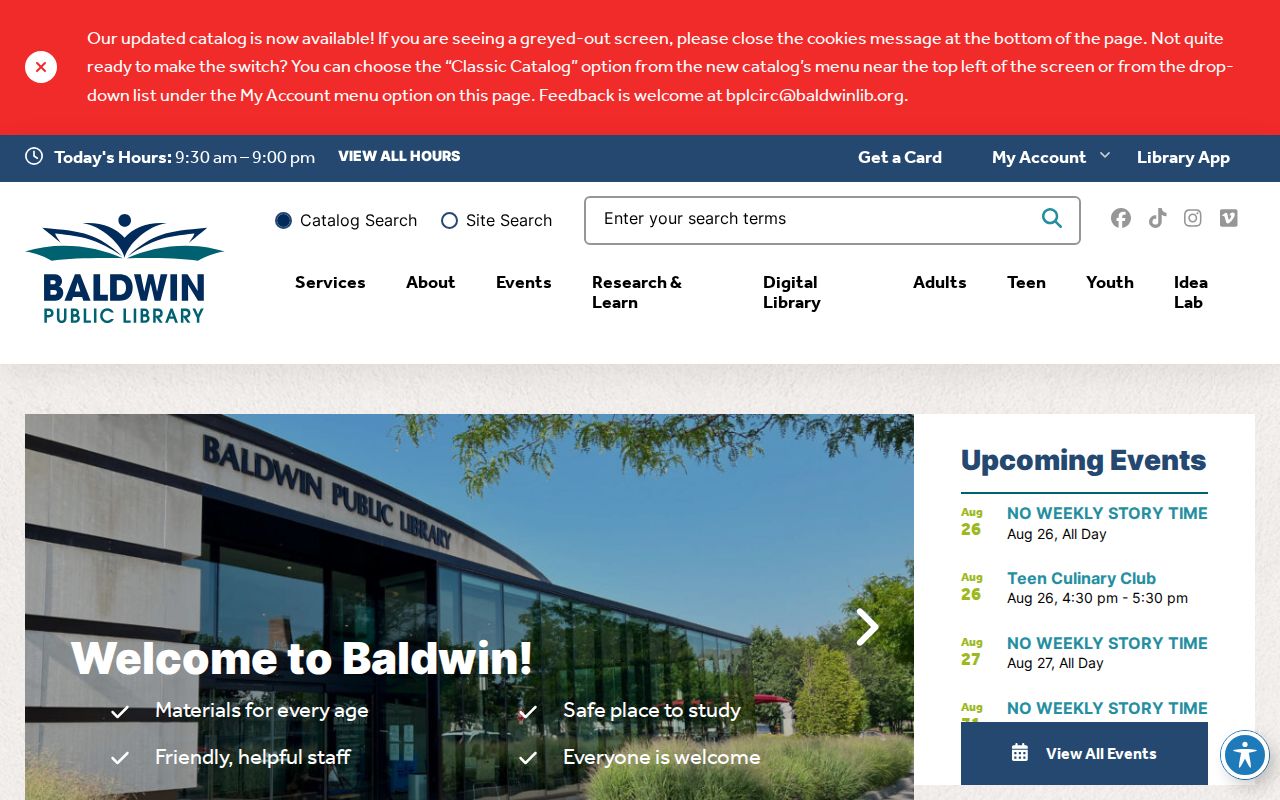
Use the catalog and staff route to learn what you can inspect inside the building. Then log the volume and page beside every finding from this residents directory search.
Note: A catalog hit confirms a library description, while the printed volume itself remains the true source for an entry.
Birmingham City Directory Shelf Evidence
The Oakland County Historical Society shelf list stands out. It names actual Birmingham volumes instead of describing a broad subject area. The group was founded in 1874 and was formerly the Oakland County Pioneer and Historical Society. It operates from Pine Grove in Pontiac. Typical hours are Tuesday through Thursday, 11 a.m. to 4 p.m., with contact advised otherwise. The office lists 248-338-6732 and office@ocphs.org.
Its wider holdings help when a directory name blurs into another local person. The society holds Birmingham history materials tied to Helen Alliene Shaw. It also holds bicentennial agendas and newsletters from 1974-76, board rosters from 1966-84, a 1748 Northlawn Drive property item, an 1822 Birmingham Post Office letter, and an 1838 village item. The Pioneers of Oakland County collection is indexed by name and community but not digitized. So ask about the box, folder, date, restrictions, and scan cost. Do not assume an online image exists.
The historical society's directory shelf list backs the holding evidence shown in this image.
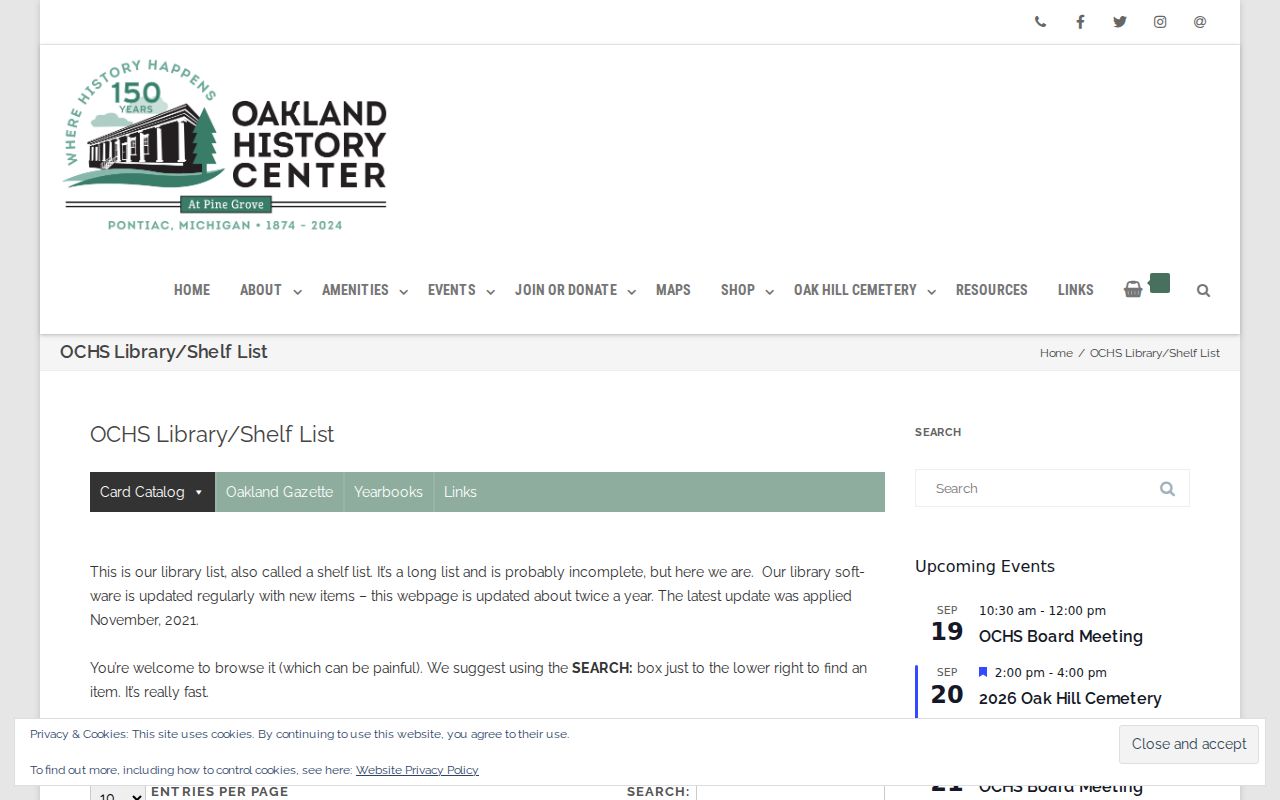
The list opens a request for access. It does not prove every listed directory page is digitized, or that staff assistance is unnecessary. A past-residents search still runs through the custodian.
Reading a Birmingham City Directory Entry
Never force a generic directory format onto the Birmingham record. Local entry images were not examined for this page. Copy only what the specific page shows: publication year, volume and page, surname, given name or initials, street address, printed business or role, telephone, spouse or household notation, and any cross-reference. That inventory describes what a page may hold. No Birmingham entry carries every field.
| Publication point | Record the directory year, volume, and page before comparing names. |
|---|---|
| Name form | Preserve the surname, initials, spelling, and any printed cross-reference exactly. |
| Address text | Copy the address as printed, including old street wording and abbreviations. |
| Household clue | Log a spouse or household notation only when the page actually prints one. |
| Role descriptor | Keep any printed business or role wording as a dated clue, not a statement of present identity. |
- Criss-cross directory
- A directory section arranged by address or street rather than by surname. It can help test whether a printed address is associated with another listed household.
- Householder index
- An index that organizes entries around a household head or address. Its meaning depends on the volume's own instructions.
- Abbreviation key
- The explanatory key printed in a volume, often near its beginning. Photograph or transcribe it before interpreting initials or marks.
A directory appearance is a dated listing, nothing more. Treat it as a snapshot rather than a permanent profile, since street names, numbers, and mailing habits have all shifted over time.
Birmingham City Directory Time Markers
Birmingham's record layers grew in stages. The city incorporated in 1933. Village, township, county, church, and cemetery material may predate that municipal system. The 1937 Polk's volume therefore sits near the start of the city period, though it is not necessarily the first Birmingham directory ever produced.
- 1830s: Birmingham's historic downtown dates to this period, so older references may sit in non-city record systems.
- 1933: Birmingham incorporated as a city, creating a clearer municipal record layer.
- 1937: The OCPHS shelf list confirms a Polk's Birmingham City Directory for this year.
- 1983-85: The same shelf list confirms Polk's Birmingham volumes for each of these years.
- 1986: The list names a Birmingham-Bloomfield Hills Community Directory.
The timeline marks documented points, not continuous publication, so catalog and archival inquiries still bridge the gaps between known dates.
Birmingham Microfilm and Newspaper Numbers
Baldwin's newspaper holdings are large. A 2025 board packet lists 2,149 microfilm reels across 11 topics. The topics chiefly feature the Detroit News and the Birmingham Eccentric. The earliest Eccentric issue dates to May 2, 1878. A microfilm indexing project ran from December 19, 2024 through March 28, 2025. All of it makes the collection a strong companion to a Birmingham city directory. It is not a replacement.
Newspapers reward patient searching. Try a full name. Try initials, surname variants, a street name, an organization, and a date range. Log every hit. Write down the issue date, page or reel reference, headline, and item type. An obituary, legal notice, social note, property notice, civic report, or advertisement may point to a further source. But a newspaper mention by itself never proves a legal address.
Note: Ask staff whether an issue is indexed, reader-accessible, or held only by reel request.
Birmingham Museum and State Archives
The Birmingham Museum research service adds local context a printed directory may omit. Tours and research both need appointments. Public hours run Tuesday through Saturday, 1 to 4 p.m., with research staff hours Tuesday through Friday, 9 to 4. Its digital collections and virtual exhibits point toward city, school, fire-department, Indigenous, and Black-history material. Search fields differ by collection.
Need a state-level fallback? The Library of Michigan family-history resources cover city and county histories, newspaper clippings, cemetery transcripts, vital records, and plat maps. They suit confirmed local items missing from Baldwin or OCPHS. Michiganology helps too. So does the FamilySearch catalog. Before calling any record digitized, name its repository and collection identifier.
Book through the museum's research page.
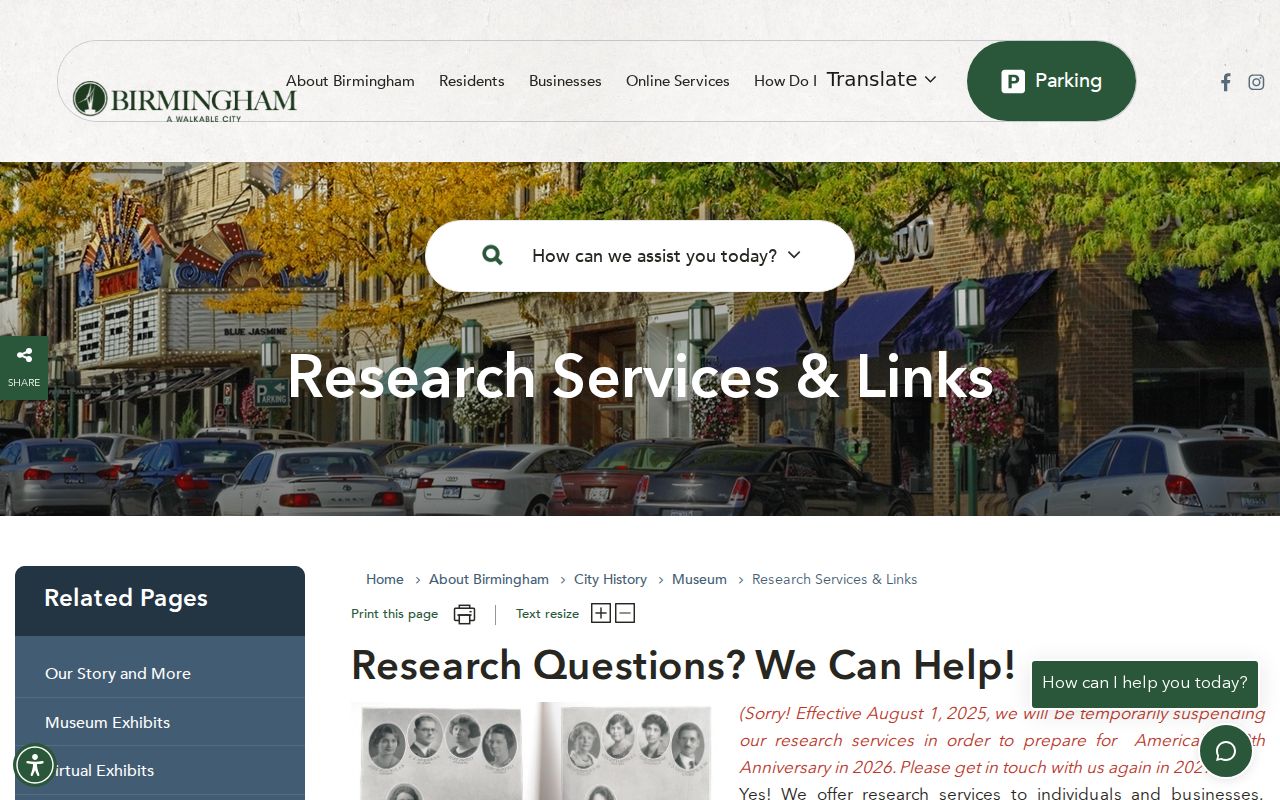
An appointment can help locate photographs and local files. Whatever turns up, hold onto the source date, title, and any stated reproduction restriction.
Tracing Birmingham City Directories by Household
A household trail works best when every entry carries its own publication date. Follow the surname through the confirmed directory years. Compare address text carefully each time. A census schedule, deed, cemetery lead, or newspaper item works only as a separate dated check. For a current parcel or an address-based deed chain, the Birmingham street directory route draws on different records. Keep that work apart from this historical shelf work.
- Start with the nearest confirmed directory year and copy the full citation before making a name match.
- Search earlier and later listed years for spelling changes, initials, and address shifts.
- Use any criss-cross section only after reading that volume's abbreviation key.
- Pair an address change with a census, deed, newspaper, cemetery, or municipal record from a similar date.
- When the trail stops, ask Baldwin, OCPHS, or the Library of Michigan for the next available holding rather than assuming a departure date.
People vanish from a directory for many reasons. A move, a death, a changed listing practice, a missed scan, or a volume gap can all explain it. Preserve the uncertainty until another dated record settles it.